
PART 3 OF Packetalk Technologies’ Building Public Trust in Law Enforcement Technology series
Public-safety agencies increasingly rely on technology that connects cameras, networks, analytics and information systems across departments and jurisdictions.
These connections can improve situational awareness, reduce information silos and support coordination when incidents extend beyond organizational boundaries.
But greater connectivity also introduces important questions about information access, data sharing and responsibility.
Connecting public-safety systems should not mean providing unrestricted access to the information they contain.
Building public trust requires an approach to interoperability that supports operational collaboration while preserving agency control and enforceable safeguards.
Interoperability Should Be Permissioned, Not Automatic
Information sharing can provide significant public-safety value.
An investigation may cross municipal or county boundaries. An agency may need information generated by another jurisdiction. Existing technologies from different manufacturers may need to contribute to a more complete operational picture.
Interoperability can help address these challenges.
However, connecting systems should not automatically authorize every participating organization to access all available information.
Agencies should be able to determine which users, organizations and systems are connected, what information may be exchanged and the purposes for which access is permitted.
Those decisions should reflect applicable law, agency policy and documented operational requirements.
For example, connecting automated license plate recognition (ALPR) systems across jurisdictions may support authorized investigations without requiring unrestricted access to every participating agency’s records.
The objective should be controlled interoperability—not unrestricted information aggregation.
PRO TIP
Agencies should be able to determine which users, organizations and systems are connected, what information may be exchanged and the purposes for which access is permitted.
Agency Control Must Remain Central
Responsible interoperability requires clear boundaries around access and information sharing.
Agencies should retain meaningful authority over their information and the relationships through which it may be accessed.
Depending on the technology, this may involve defined user permissions, approved interagency connections, restrictions on secondary uses and mechanisms for suspending access when necessary.
Sharing relationships should also be reviewed periodically.
A connection that was appropriate when established may need to change as operational requirements, participating organizations or applicable regulations evolve.
Technology architecture should support these decisions rather than impose a single approach to data sharing.
Packetalk’s approach to connected public-safety solutions emphasizes integrating existing and multi-vendor technologies while supporting defined permissions and agency-controlled sharing relationships.
This allows agencies to pursue the operational benefits of connectivity without treating every connection as an authorization for unrestricted access.
Technology Vendors Share Responsibility
Public trust is not solely the responsibility of law-enforcement agencies.
Technology providers also influence how effectively agencies can govern the systems they deploy.
Vendors should be prepared to address questions involving cybersecurity, access controls, auditability, data handling, interoperability and the ability to enforce agency policies.
Contracts and data-sharing agreements can help translate those expectations into documented obligations.

Important considerations may include agency control of information, restrictions on unauthorized secondary use, security requirements, incident notification, deletion procedures and approval before new sharing relationships are established.
A responsible technology partner should help agencies understand both the capabilities and governance implications of connected systems.
The vendor’s role should extend beyond delivering equipment or software.
It should include supporting implementation decisions that align with an agency’s operational needs and its responsibility to protect information.
Public Trust Depends on Enforceable Limits
No technology program can credibly promise that misuse is impossible.
The stronger approach is to establish safeguards designed to prevent inappropriate activity, detect potential violations and support meaningful review and corrective action.
Those safeguards become particularly important as public-safety systems grow more interconnected.
Agencies should be able to explain not only what their technology can do, but also what users, connected organizations and vendors are prohibited from doing without appropriate authorization.
Public trust is strengthened when those limits are documented, technically supported where possible and subject to accountability.
Responsible Innovation and Public Trust
Effective public-safety technology and responsible governance should advance together.
Clear operational purposes establish why technology is needed. Privacy safeguards define appropriate boundaries. Transparency and accountability help demonstrate that those boundaries are respected.
Responsible interoperability extends those principles across connected systems and participating organizations.
Together, these practices support a more complete approach to public-safety technology—one that values operational effectiveness while recognizing the importance of public confidence.
The goal is not simply to connect more technology. It is to connect technology responsibly, with meaningful safeguards and agency control.
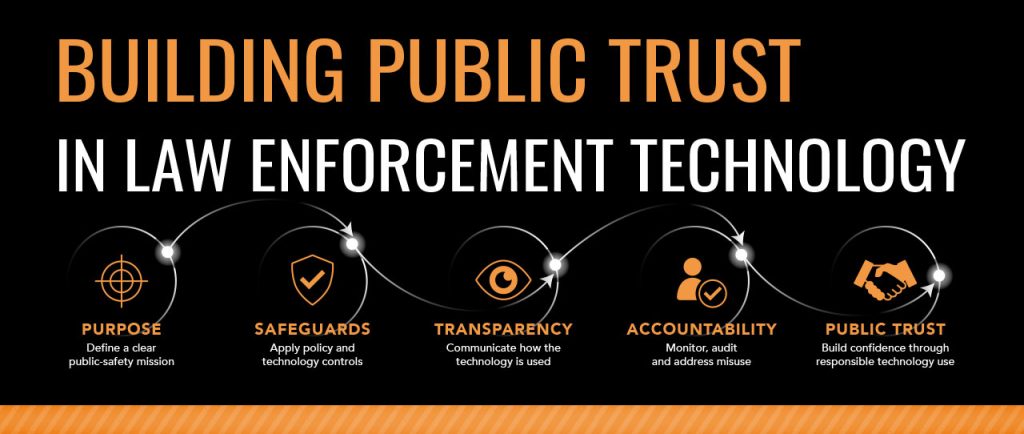
IN REVIEW, Responsible interoperability connect technology responsibly, with meaningful safeguards and agency control.
READ PART 3 READ PART 2 READ PART 1About Packetalk Technologies
Packetalk Technologies develops connected public-safety solutions, including connected cameras, intelligent video analytics, public-safety networking, mobile ALPR and rapidly deployable surveillance systems.
Explore Packetalk’s Connected Public Safety Solutions.